This River Valley apartment channels Japanese minimalism – and it’s built for real family life
Beyond the look of Japanese design, the home is organised around rituals: sleeping, dining, play and bath time each have dedicated zones, anchored by a contemporary doma arrival sequence and tatami platforms.
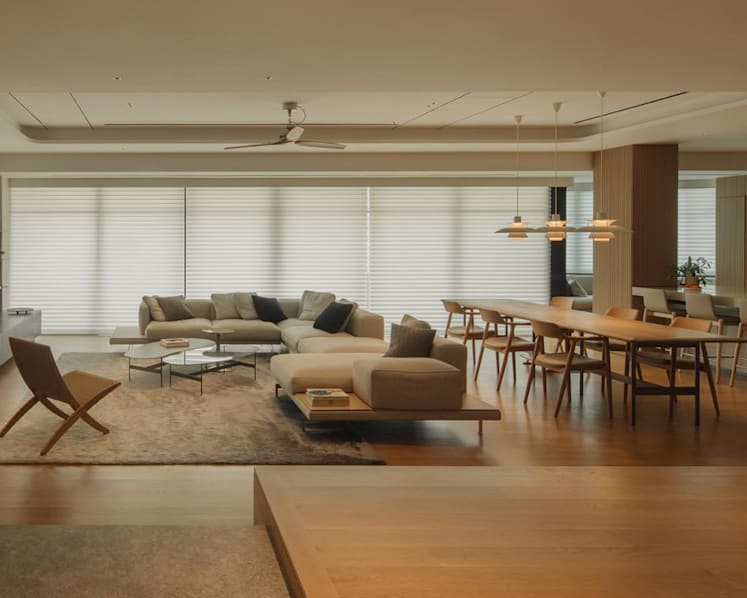
Designed for owners who once lived in Japan, this home reflects the rhythms they missed: shoes-off arrival, tatami-based lounging, and a floor plan that keeps sleeping and play firmly apart. (Photo: Khoo Guo Jie)

This audio is generated by an AI tool.


With its traditional doma – a Japanese-style entryway where shoes are removed before stepping up into the home – tatami mat area and minimalist lines, this apartment is, at first glance, a clear homage to Japanese design. While Singapore has many homeowners and designers skilled in this aesthetic, this particular project offers far more than its initial impression suggests.
Led by Leong Lai Ping from K2LD Architects, Sora House, as it has been christened, differentiates itself by embodying Japanese living rituals, such as a clear separation between the sleep and play zones. This was part of a wish list from the owners – a husband-and-wife couple who live with their three children, all under the age of eight.
Their desire for a Japanese, lifestyle-driven home stemmed from having lived in the country before moving to Singapore. When they bought this 2,700-sq-ft penthouse apartment in River Valley, they were adamant about recreating what felt most familiar.
Leong confessed that she had reservations at first: “They contacted us via our website. I was a bit uncertain about how we would work together, because they come from a different culture and design sensibility. What helped was that they were both quite modern and open to suggestions.”
On her part, she listened intently to understand how they wanted to live in the apartment. One of the first things she learnt was that sleeping, dining, play and bath time were serious business. And because never the twain shall meet, dedicated spaces had to be carved out in the floor plan.
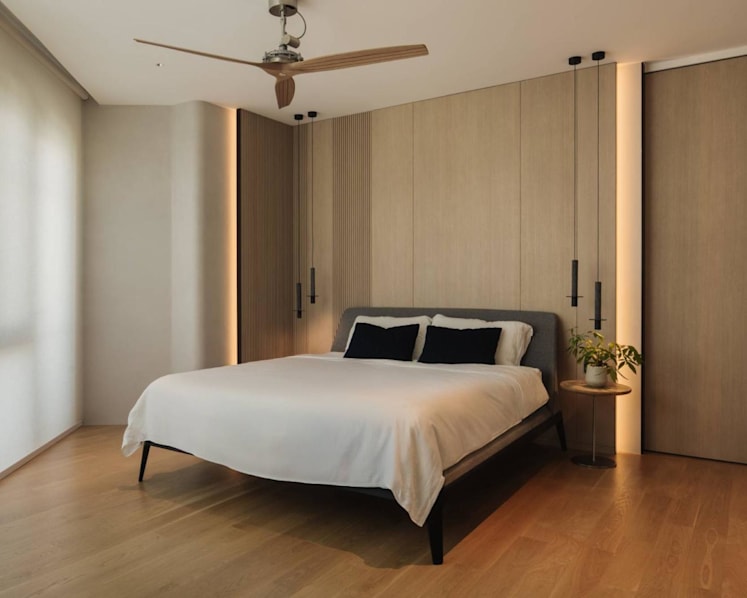
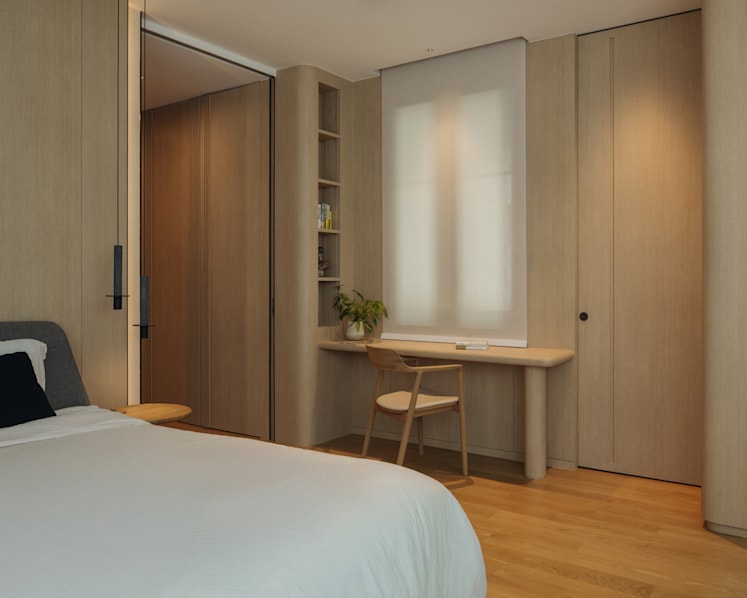
“For instance, the bedrooms are purely for sleeping, so one end of the unit is a quiet area, where the walls and doors are acoustically treated. Once the children are asleep, their parents can enjoy a glass of wine or watch a movie, without fear of waking them up,” Leong said.
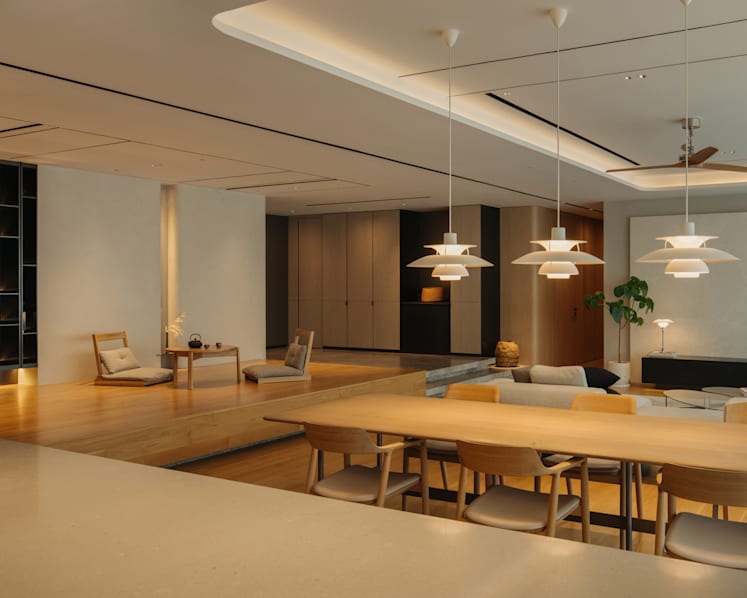
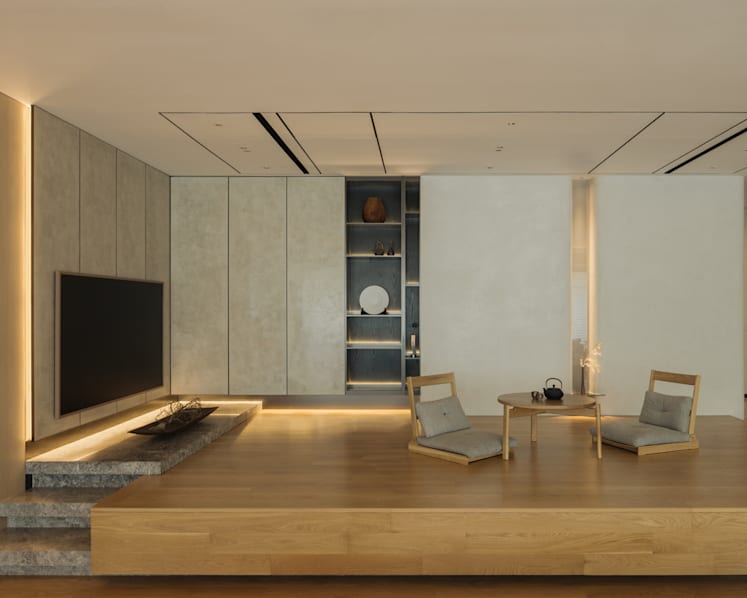
Beside the two bedrooms are the living room, dining area and kitchen, laid out in an open-plan arrangement. An elevated tatami platform flanks the space, where the children can play with their trains and dolls. An alcove by the kitchen holds another sofa and table for activities like colouring and painting. Beyond that is a third child-friendly zone: a playroom by the service yard that keeps the kids close when their mother, a homemaker, cooks.
With the bath ritual an important part of the family’s culture, Leong paid special attention to it too. All five members use the same bathroom for their ablutions; it sits beside the kitchen. To ensure there was enough space, she doubled its size to accommodate a tub, shower area and his-and-her sinks.
Care was taken to limit the wet zone. “When the kids jump in and out of the tub, the water will splash out. We did a lot of tests to ensure that the water does not flow out of the shower area,” Leong shared. The end result was a customised screen door with a magnetic mechanism to seal the area off.
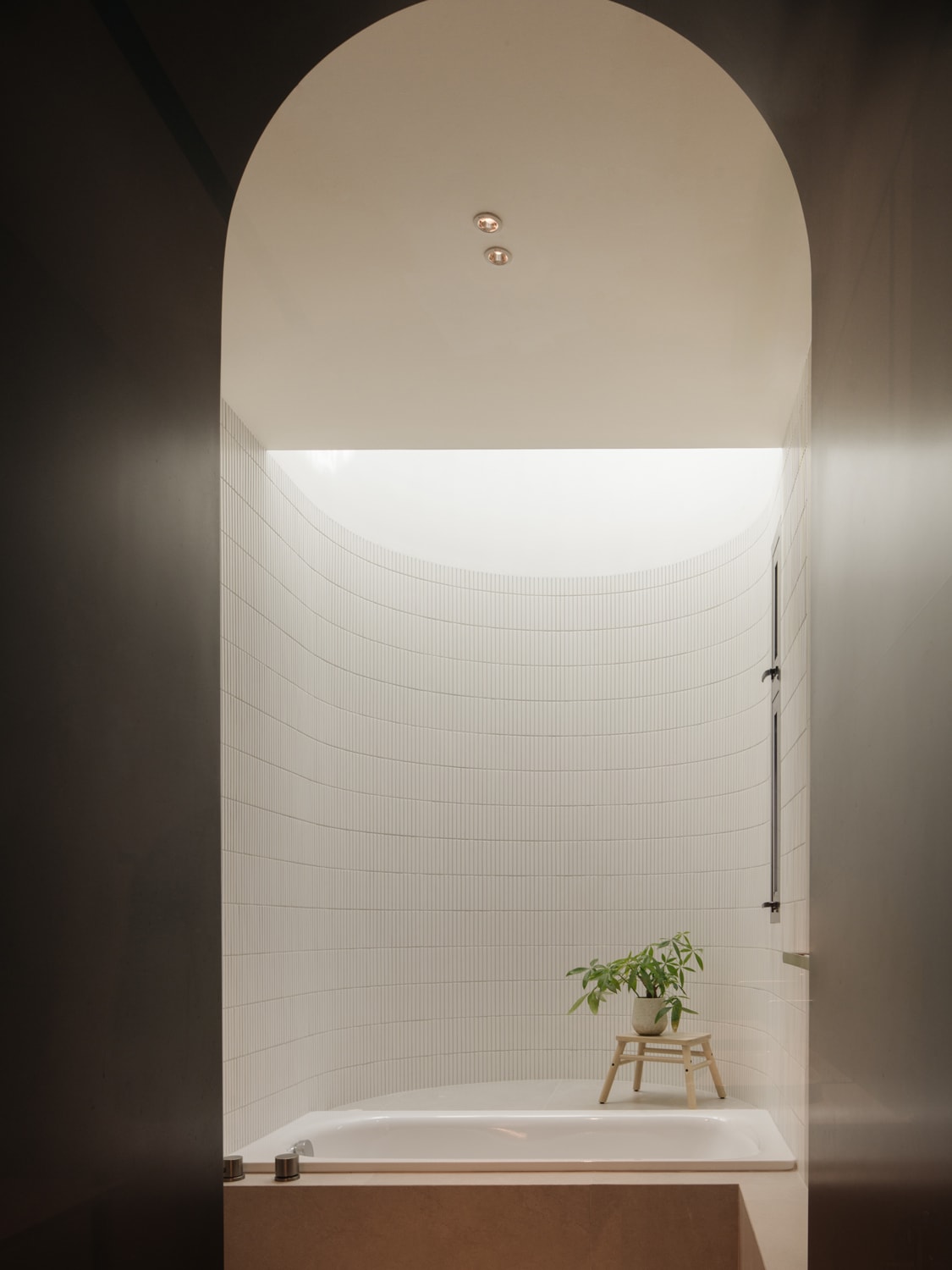
Less obvious – but no less vital – was the need to keep the bath water warm at all times. To ensure this, she saw to the installation of three heaters that run concurrently. The cherry on the cake is that the wet zone sits within a curved bay that projects from the building. Because the unit is on the top floor, the ceiling here is a skylight.
“We focused on cleaning up the space by changing the existing tiles to off-white kit-kat tiles, which allow light to scoop in more dramatically. This pares it down to its minimal essence,” she added.
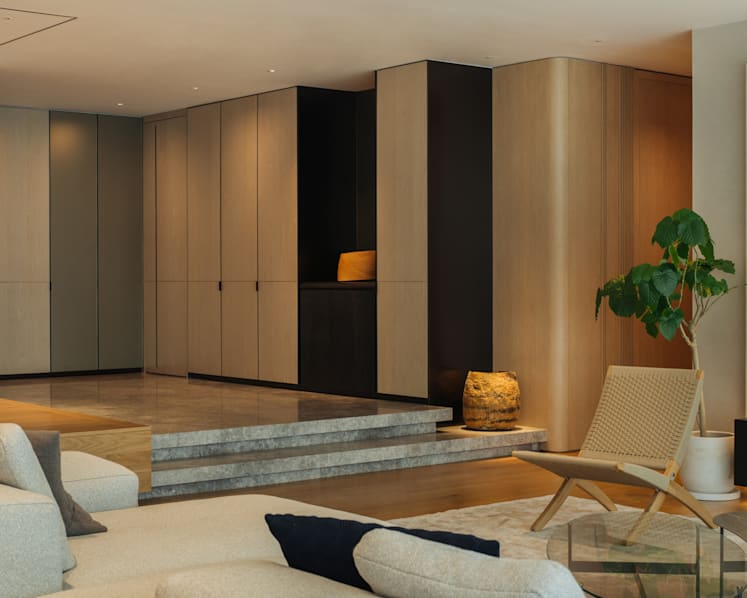
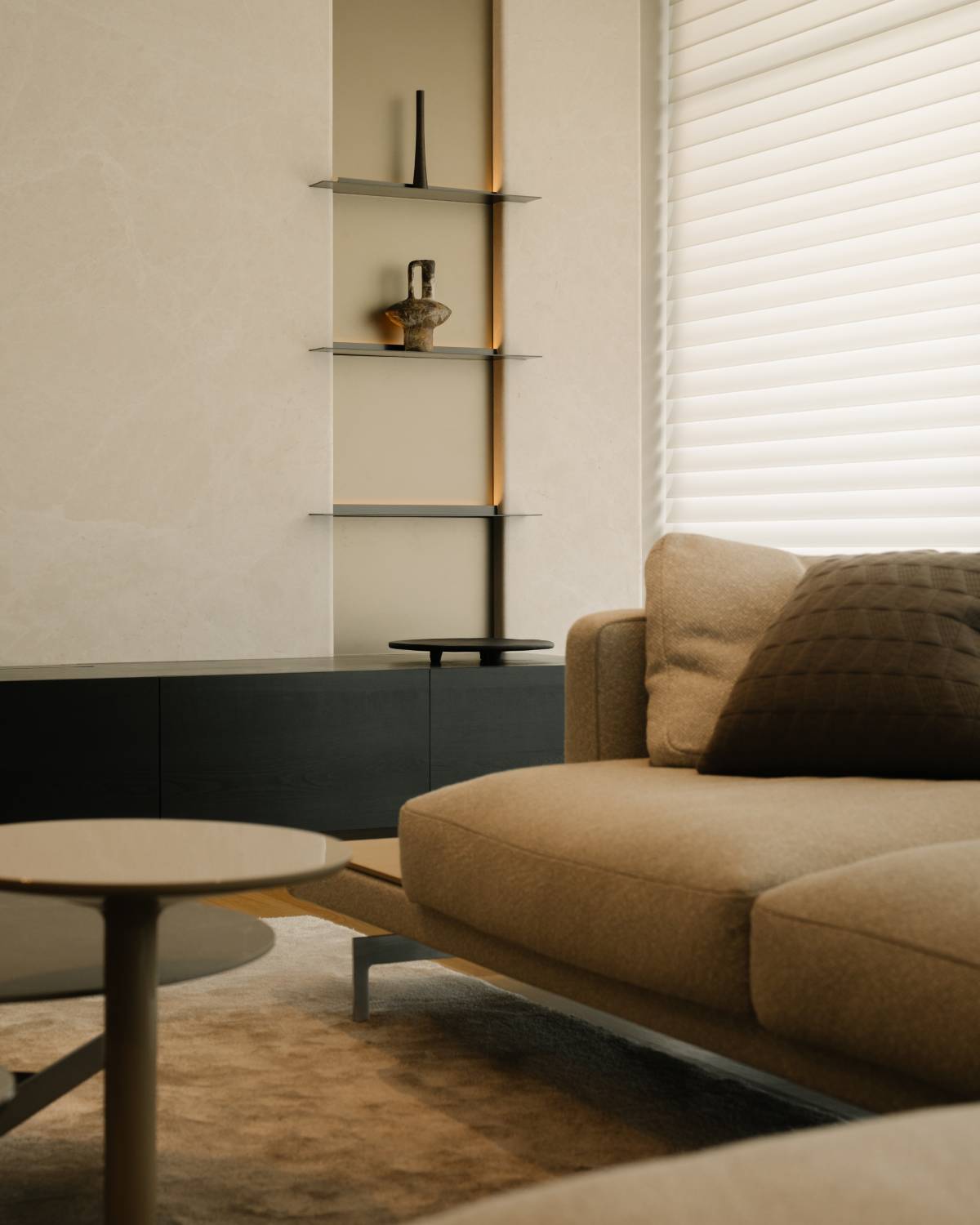
With the Japanese living rituals taken care of, attention turned to other facets of the apartment. At the entrance, a contemporary doma defines the arrival experience, inspired by those found in traditional Japanese houses. A pair of curved walls is bridged by a slender aluminium shelf holding an ikebana arrangement. Underfoot, grey Baltic marble demarcates this transitional space.
Behind this is a tatami area, currently devoid of the mat. The prospect of cleaning it if bits of food or liquid are spilled has convinced the owners that they will only lay one when the children are older. For now, a pair of floor chairs (zaisu) and a low coffee table occupy the platform.
Moving further in, you are immediately greeted by the communal spaces. Leong explained: “When we first came to the house, we were quite impressed with the view, as well as the horizontality of the whole apartment. We countered this by using curved edges on the walls to create a softer space. The rounded architecture of the building also inspired us.”
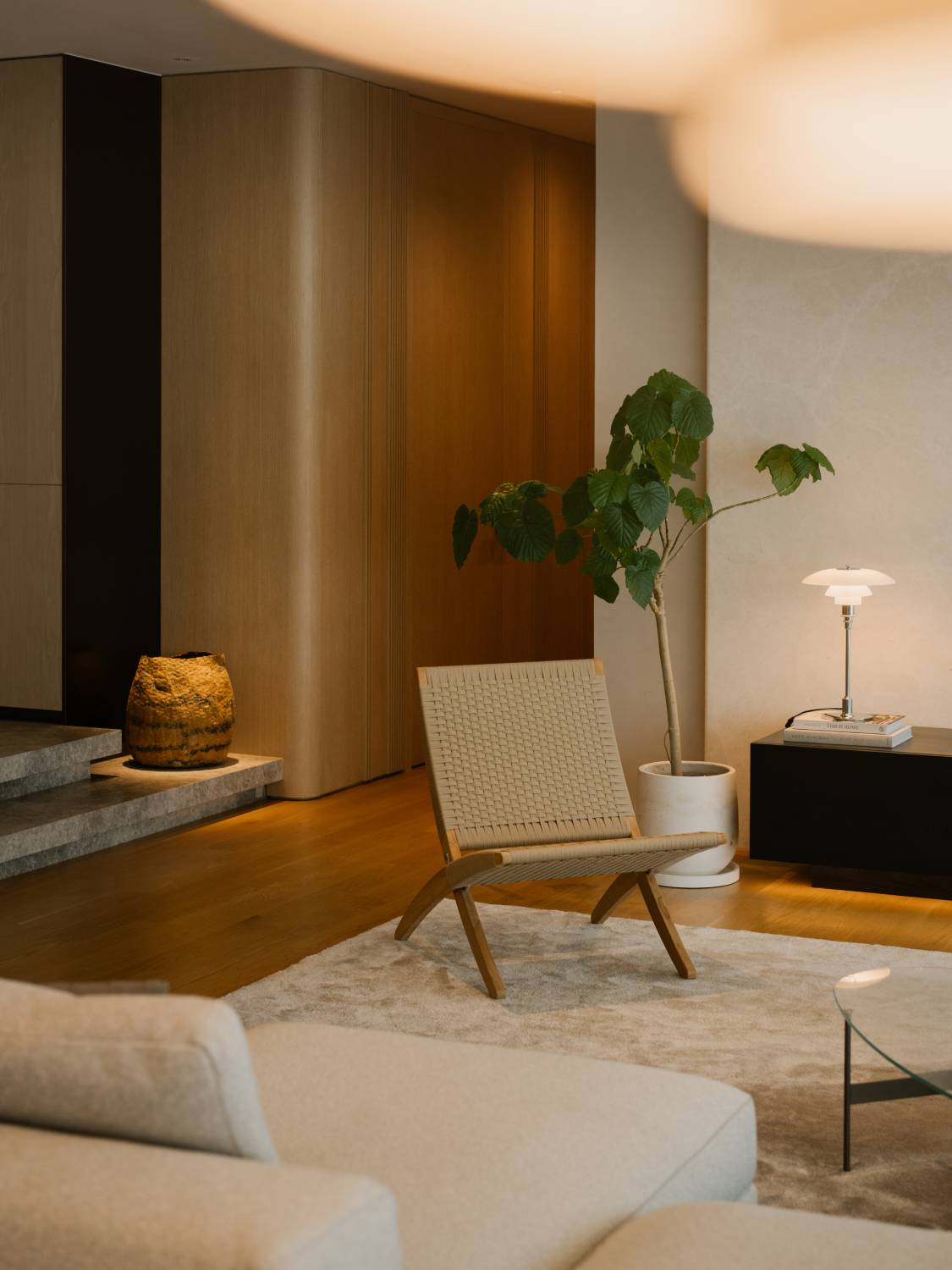
To mitigate the relatively low ceiling height of 2.4m, she recessed the section above the living room. There, a plush sofa from B&B Italia takes centre stage, set before a television console anchored by a book-matched Italian marble wall from Surface Stone. Morten Gottler’s elegant Cuba Chair, with its intricate fabric weave, acts as an accent.
Nearby, a 3.2m dining table by Ritzwell is paired with a mix of Hiroshima and Style & Craft dining chairs, comfortably seating eight. Above, a trio of PH 5 pendant lamps by Louis Poulsen anchors the space.
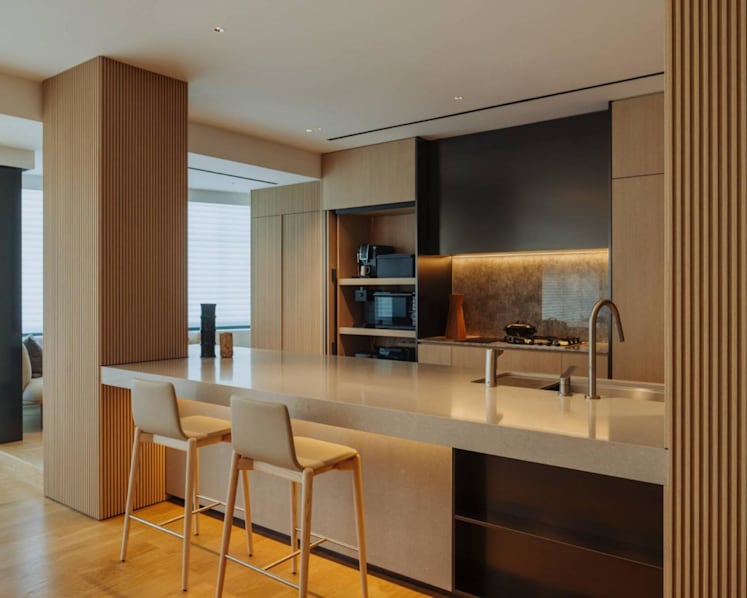
Carpentry skilfully conceals appliances, including a powerful hood from Fisher & Paykel. Given the open nature of the space, Leong ensured this section reads like a show kitchen, yet is fitted with all the necessary bells and whistles to feed two adults and three young ones.
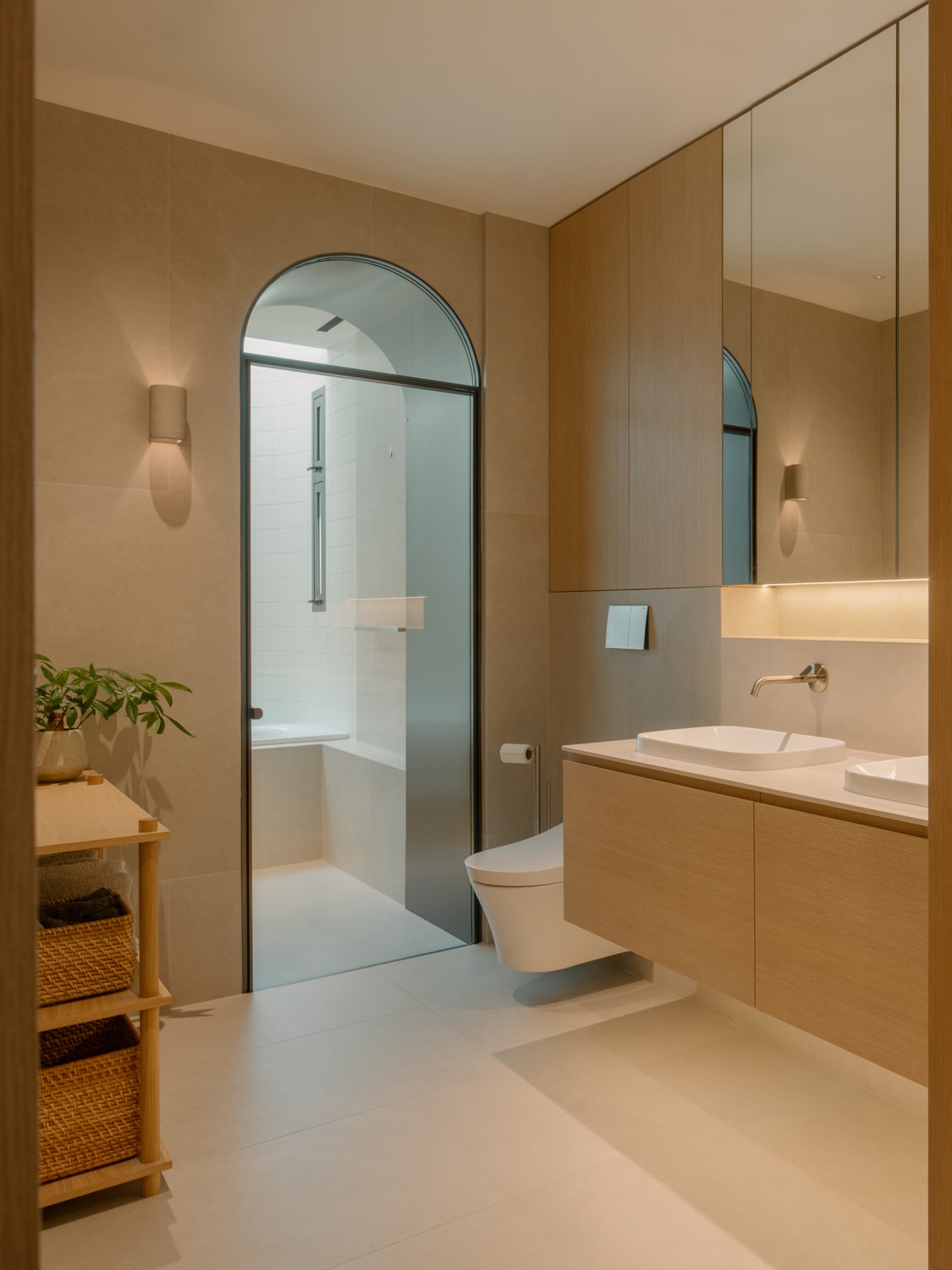
Unifying the entire apartment is a consistent material and colour palette. Japanese oak covers the floor and cabinetry. It also clads a few walls, including the fluted columns. Lime wash paint is found in the backsplash of the kitchen and in the tatami mat area, while blackened steel serves as accents.
Illuminating all that effort is the careful, considered use of lighting. Working with Japanese brand Endo, Leong introduced ceiling coves for that ambient glow, while strategically placed downlights shine on the furniture and decor. Newly replaced double-glazed floor-to-ceiling windows and doors let in daylight.
Several months after the owners moved in, Leong went back for a visit and was pleased that the integrity of the design had been retained. She was particularly enamoured of the calm, homely and highly curated sanctuary she had created. Given its size, it would have been easy for the owners to ask for a showy spectacle that ranked high on the luxe factor – but they chose otherwise..
“At K2LD, we have done several large apartment fit-outs and many of them tend to be loud and richly textured. With Sora House, named because it means ‘sky’ or ‘the heavens’, I feel like we have gone back to what we used to do: focusing on the honesty of the material and a consciousness towards being quiet. It has the humble feel of a family home that will be there for a long time,” said Leong.