This might be the best hotel transfer in Bali – and the most beautiful
Between Four Seasons Resort Bali at Jimbaran Bay and Four Seasons Resort Bali at Sayan, getting from one hotel to the next means swapping a car ride for a raft journey down the Ayung River.
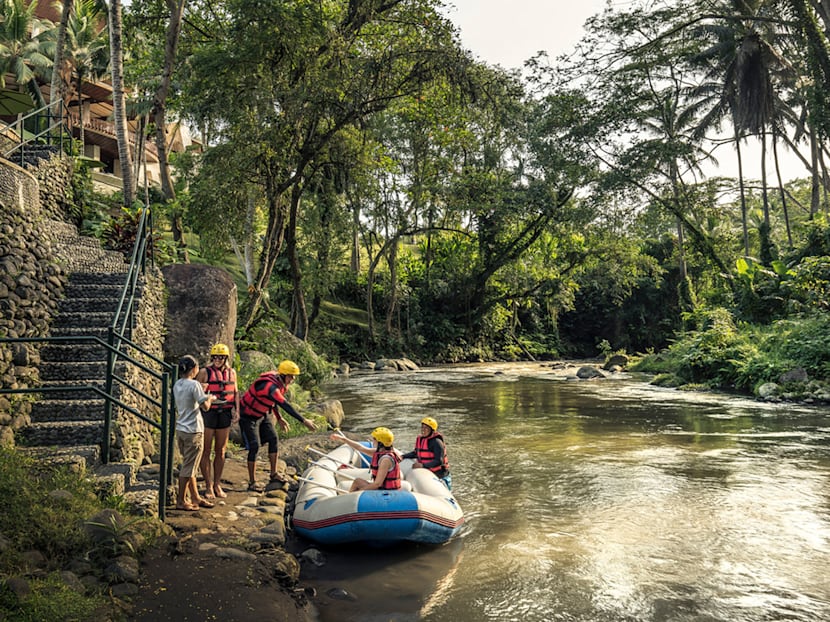
The transfer from Four Seasons Resort Bali at Jimbaran Bay to Four Seasons Resort Bali at Sayan ends with a raft arrival on the Ayung River. (Photo: Four Seasons Resort Bali at Sayan)

This audio is generated by an AI tool.


Let’s be blunt. Most hotel transfers are an exercise in managed disappointment. You’ve just spent three days in paradise and now, through absolutely no fault of your own, you’re in the back of a clunky taxi watching the resort shrink in the wing mirror, trying to remember which app has your next booking on it. The dream, briefly, is over.
The Four Seasons has a different idea. Between its two Bali properties – Jimbaran Bay on the sun-blasted southwestern coast and Sayan in the northern rainforest highlands in Ubud – runs the mythic Ayung River, and the resorts will, if you ask them to, put you on it in a raft and let the current carry you from one to the other. It is, in my view, hands down, the best hotel transfer in the world.
The downside is that the transfer works in only one direction: south to north, coast to mountain. Unless you happen to be a salmon.
There is another small catch. The journey begins with a two-hour drive north from Jimbaran Bay to Bongkasa village – a small settlement on the rim of the Ayung Valley that serves as the departure point for the raft. So, calling this a direct hotel transfer would be, technically, untrue. But the car does come with cold towels, tinted windows, WiFi, and the quiet confidence of people who know you’ll forgive them the moment the valley swallows you whole. So, there’s that.
First, though, Jimbaran Bay earns its goodbye. The late Made Wijaya – the legendary Australian-born landscape architect who spent decades in Bali and effectively invented the modern Balinese garden – shaped the resort’s 14 oceanfront hectares into something that has only deepened with age. His apotheosis may have been Amandari in Ubud, but Jimbaran Bay was one of his grandest canvases: 147 walled villas nestled among temples, shrines and water gardens, the sandstone walls furred with lichen and moss as though the jungle has been slowly, gently reclaiming them ever since.
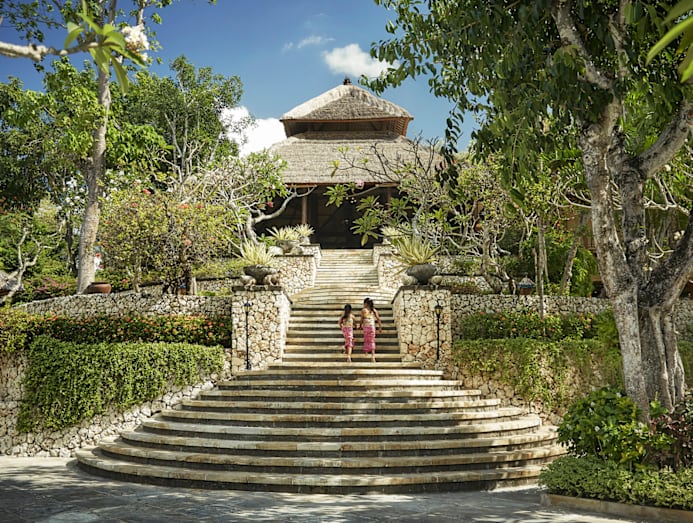
And everywhere you turn, Bali peeks through, not least the lily ponds, the profusion of sacred frangipani, and the resort’s collection of over 300 palinggih, or Hindu shrines, scattered throughout, including one dating to the 15th century.
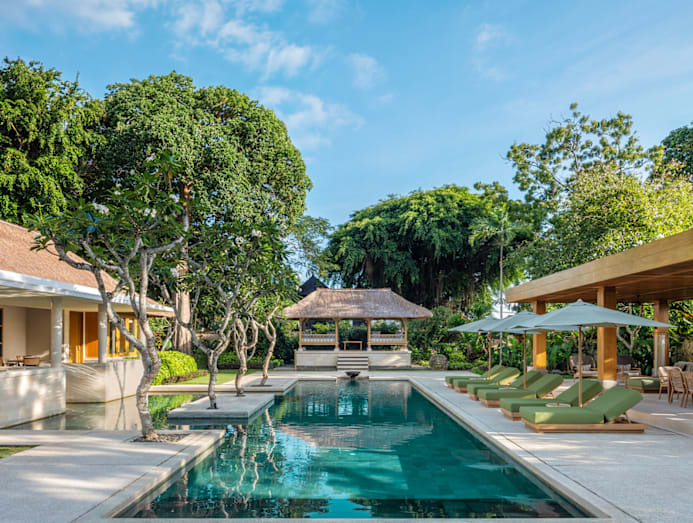
Water splashes everywhere. It can get really hot on this coast, which makes the villa plunge pool less of an amenity and more of a survival tool. From the water, you can watch the silent silhouettes of aircraft trace arcs over the bay – close enough to see, far enough that you hear absolutely nothing. Sundara, the beachfront restaurant commanding the island’s longest beachfront pool, sends you off with Indonesian archipelago cooking over five courses, and the sunset over Jimbaran Bay is the sort that makes you briefly reconsider every life decision that led you to check in somewhere else.
Then, the river.
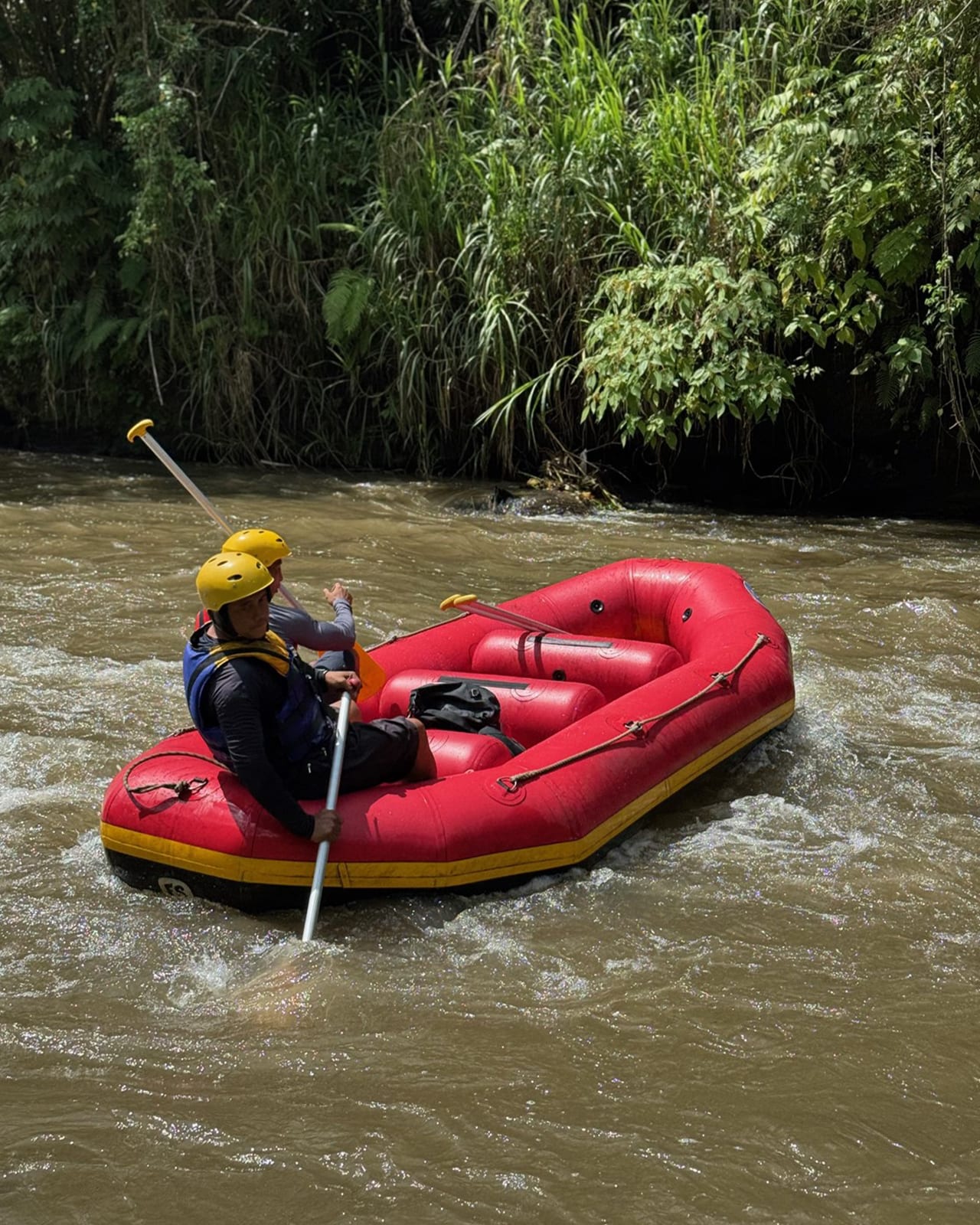
Two hundred steps descend from Bongkasa to the valley floor, where the Ayung tumbles melodically over rocks and river plants. The raft is red, the helmets are yellow, and your two guides have the focused good humour of people who do this every day and still find your thrilled shouts on first contact with a churning Class II rapid quietly amusing.
Almost at once, the green-cloaked canyon closes around you. The banks are lined with volcanic stone and boulders – the same dark, porous rock locals have quarried for generations to build their temples and homes – and volcanic sand that shifts and gleams in the current. Banana palms press at the water’s edge. Great banyan trees lower curtains of tendrils to the river’s surface, plunging the raft into intervals of cool, cathedral shade – the light filtering green and strange, the noise of the world above entirely gone. A kingfisher, improbably blue, flashes off a branch and vanishes.
After rain, the Ayung quickens noticeably, the current asserting itself with rather more force, and you are reminded that this is a real river with its own wild magic, not a theme park ride with a gift shop at the end.
Along the banks, local villagers have set up little watering stands hawking cold water, fresh juices. It’s entirely entrepreneurial, entirely charming, the Balinese gift for hospitality extending even to a muddy riverbank in the middle of a jungle gorge.
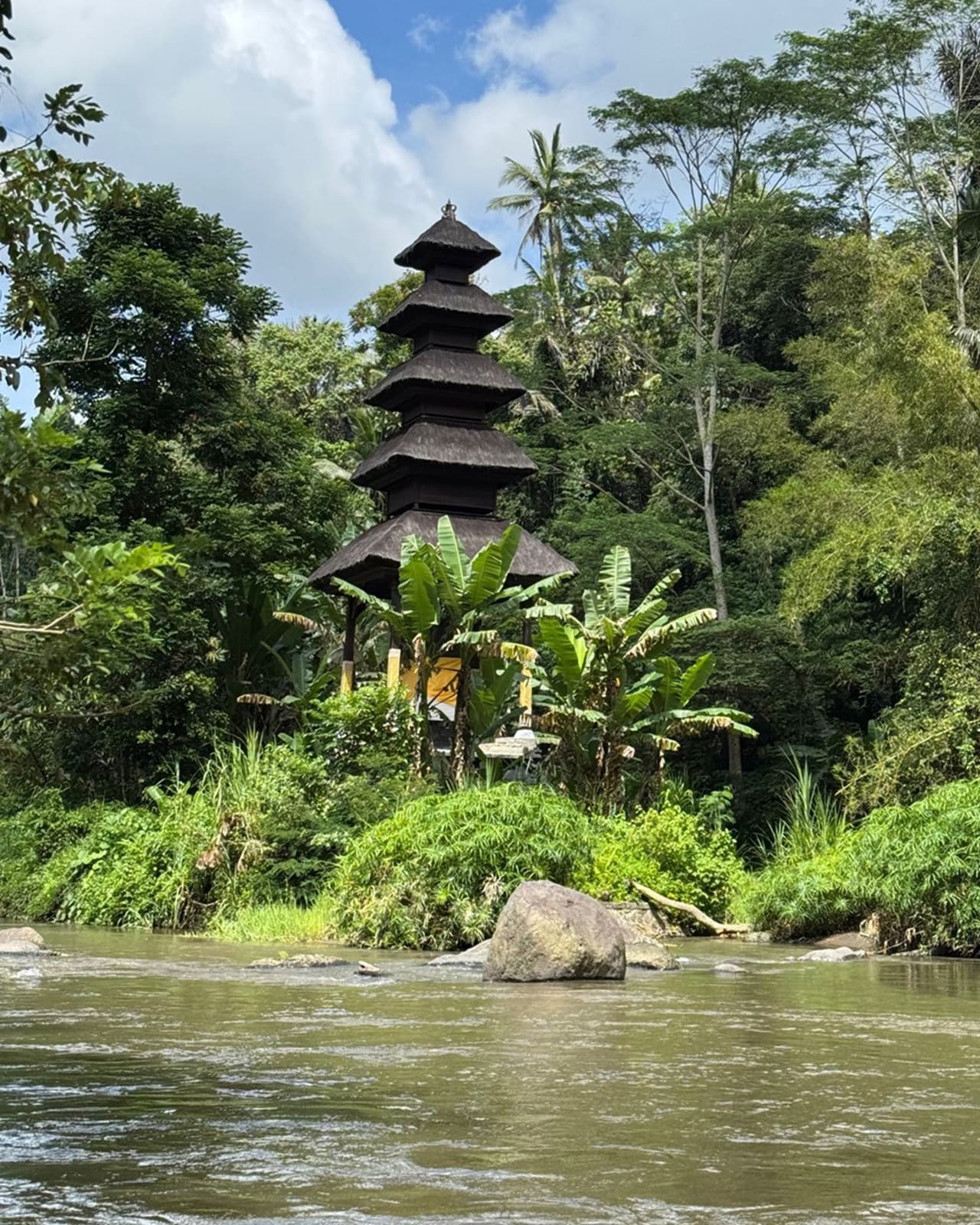
The 7km float to the Four Seasons Sayan takes between 90 minutes and two hours, and somewhere in that time the accumulated weight of travel – the flights, the schedules, the mild ambient anxiety of being a person with places to be and no margin for being late – simply lifts. At one bend, a multi-tiered Balinese temple rises from the jungle, its thatched meru towers emerging through banana and bamboo with the composure of something that has been here forever. You pass it in silence. The river doesn’t slow for temples.
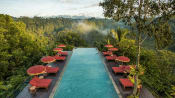
Eventually, the rapids quiet and the Ayung widens into something glassy and still, the canopy of old trees sealing overhead, and in the hush it feels exactly like arriving somewhere. Then the raft nudges a small stone platform, you climb a few steps, and, quite without warning, you are standing on the pool deck of the Four Seasons Sayan – the water stretching to an infinity edge that hangs directly over the river you just came down. It is an arrival so perfectly composed, you almost have to pinch yourself.
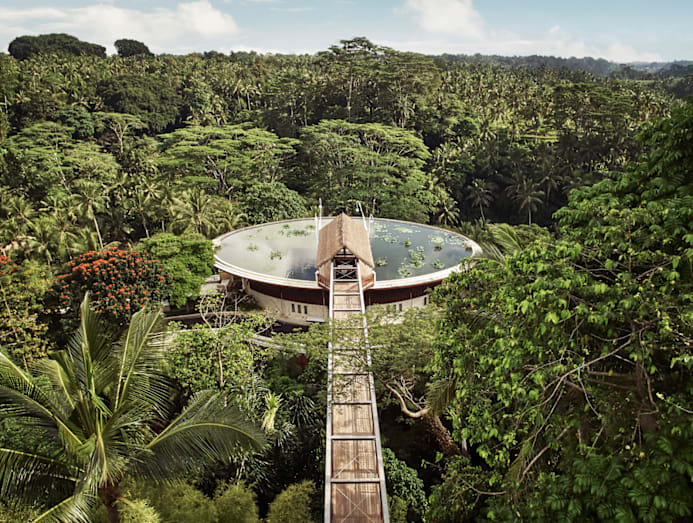
London-based architect John Heah’s 1998 design – the silhouette is inspired by a bowl of rice, the resort channelling a vessel cradling the life within – has not dated by a single day. You approach via a treetop bridge and encounter what appears to be an enormous 852 sq m, elliptical lotus pond floating above the jungle. It’s an utterly serene tableau. Descend the stairs and the Ayung Valley opens below you – gorge and canopy and the silver thread of the river, vast and vertiginous. The sleek, stone and timber clad villas are buried into the hillside and manicured, vividly green rice fields, their living areas concealed within the slope and visible from above only as a sala and thatched roof. It’s stealth privacy.
It is also much cooler up here. The mountain air carries a charge of green and birdsong, and the persistent sensation – which does not fade, however long you stay – of having stumbled into James Hilton’s Shangri-La. Though I imagine the Four Seasons guest eats considerably better than the novel’s lost protagonists. Sokasi, the alfresco riverside diner, serves exceptional Balinese recipes – babi guling, bebek betutu slow-roasted in a traditional clay oven – accompanied by an orchestra of crickets and frogs.
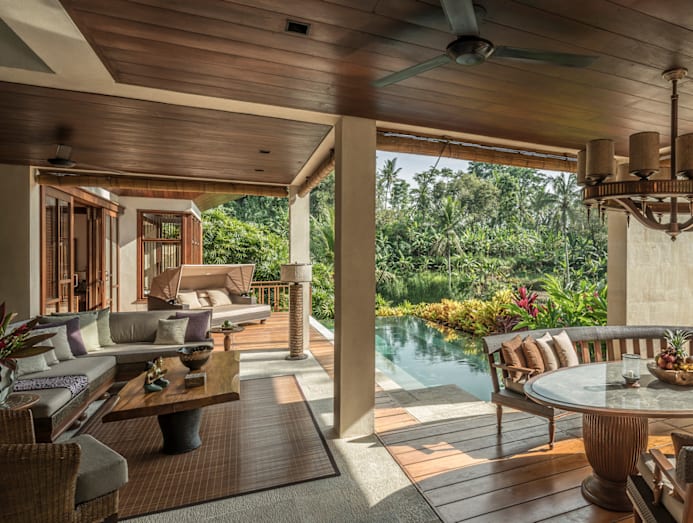
The Sacred River Spa channels the Ayung’s energy into water-centric healing rituals, while the resident wellness practitioner Ibu Fera, a former Buddhist nun, offers a Sacred Nap in an aerial silk hammock suspended from the bamboo ceiling of the Dharma Satya pavilion. I took one. I am a different person now.
Which is, when you think about it, the whole point of the exercise. The world’s best hotel transfer doesn’t just move you from one address to another; it moves you from one version of yourself to another. Sure, this requires a car, a raft, and about four hours, so it is not, by any definition, direct. But you do get to travel through three distinct Balis – coast, river, mountain – each one quieter and more introspective than the last, and it ends with you stepping off a river and straight onto a pool deck that hangs over it.
No airport gate has ever managed that.
The river rafting transfer is priced at 4 million++ Indonesian rupiah per couple (around US$230+++ or S$300++).