How award-winning Singapore designer Pann Lim turns everyday ideas into memorable experiences
He calls himself “just a normal Singaporean”, but his work is anything but ordinary. From a Merlion “fossil” to 1990s-style classrooms and a handmade family zine, Kinetic co-founder Pann Lim turns familiar moments into quietly powerful design stories.

A former musician and reluctant businessman, Pann Lim has built Kinetic into one of Singapore’s most inventive creative agencies. (Photo: Aira; Art: CNA/Chern Ling)

This audio is generated by an AI tool.


“I’m just a normal Singaporean.”
Pann Lim began the interview with this statement, said in such a matter-of-fact tone that it sparked a burst of incredulous laughter from this writer. Yet as the conversation progressed, it became clear that, by thinking of himself this way, the co-founder and creative director of Kinetic Singapore is able to do the work that he does.
Best known in design circles, Lim has, in recent years, led the creative agency in staging a series of commissioned exhibitions that turn everyday ideas into memorable, relatable lessons.
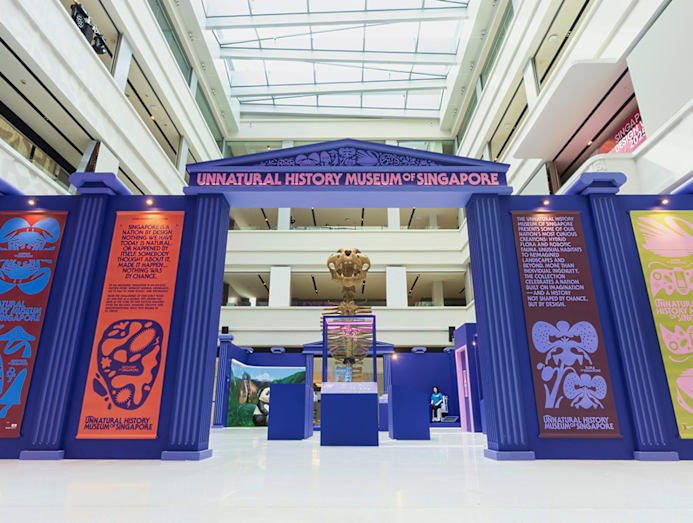
The most recent was the Unnatural History Museum of Singapore at this year’s edition of Singapore Design Week (SDW), held in September. Taking pride of place in the middle of the showcase at the National Design Centre was a Merlion “fossil” rising six metres tall.
In 2023, he worked with his team to establish the School of Tomorrow in Selegie Arts Centre. It was fitted out with classrooms, a canteen, a library and even a science lab, done in the style of public schools from the 1990s. Visitors learnt about sustainability through different subjects such as chemistry, mathematics and biology.
When asked how he developed this knack, the 52-year-old replied: “As humans, we have this tacit thing called instinct and intuition, which we build on to do the work we do. I can’t really explain beyond that.”
COMMUNICATING BEAUTIFULLY
What he can elaborate on is the tried-and-tested internal process at Kinetic that has kept the agency in business for the last 24 years. For starters, the Designer of the Year at the President’s Design Award (PDA) 2013 has been diligent in building a team of storytellers adept at tugging at heartstrings.
Those who studied in Singapore in the 1990s and 2000s would have had an instant connection with School of Tomorrow. In the chemistry classroom, for example, a light box on the wall looked, at first glance, like a periodic table.

Closer inspection revealed unusual letter combinations like DF and HU that stood for dog fur and human urine, respectively. Within each square, the “elements” were showcased with accompanying explanations of how they contributed to the sustainability narrative.
“Most people understand what a periodic table is, but they were seeing it in a completely different way. Sometimes we like to play with a bit of parody and juxtaposition,” said Lim.
The same technique was applied at the Unnatural History Museum of Singapore. The concept came about after dissecting the direction of “nation by design” for SDW 2025, laid out by the DesignSingapore Council. Despite the lack of natural resources, the country has managed to evolve from third world to first – something that is widely recognised as nothing short of a miracle.
“We started to think about how many countries have a natural history museum but has anyone seen an unnatural one before? It led us down the path of how to parody what looks like a natural history museum into our unnatural one,” explained Lim.
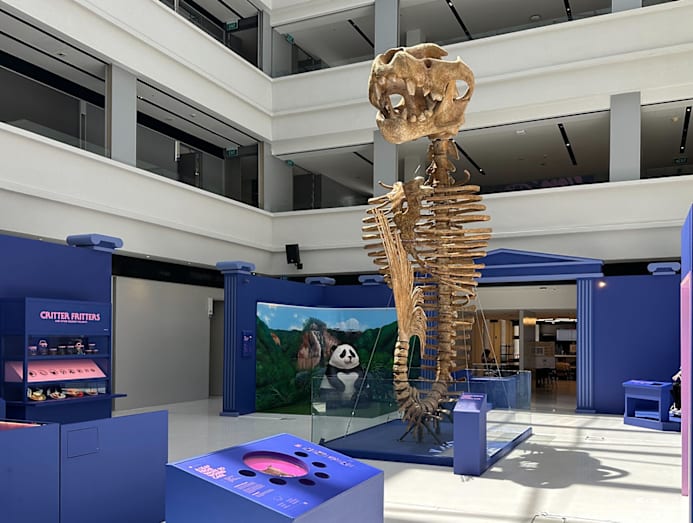
Walk into any of these attractions and dinosaur bones are typically the star exhibit. Taking their cue from this, he and his team quickly landed on a Merlion “fossil” as the centrepiece. Crafted with a steel structure covered in fibreglass, it reinforces the man-made theme of the exhibition and is also an easily recognisable symbol of Singapore.
Equally important to Lim and his team is that, when fulfilling a brief, communication should be at a level most people can understand. This means keeping any text concise yet interesting enough to hook a visitor. QR codes provide access to further information for those who are keen to learn more.
Finally, because they are a creative agency, it is important to have a strong sense of aesthetics, “because craft is in our blood,” quipped Lim.
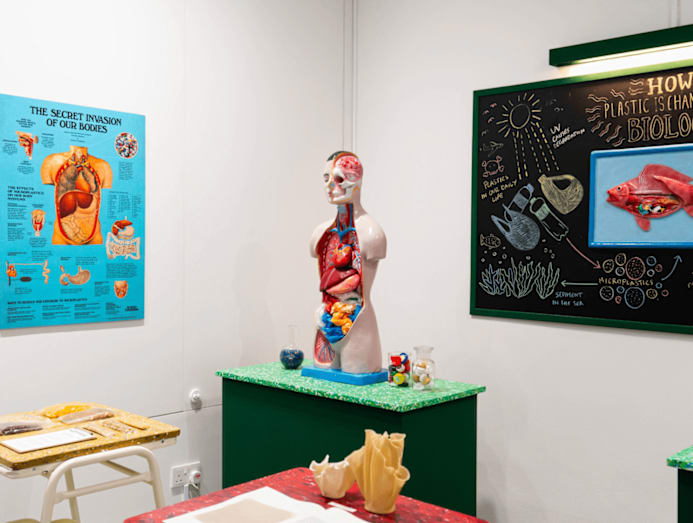
In the biology classroom at the School, the tables were the type found in public schools, but their tops were made from plastic bottle caps by circular furniture company Robries. When visitors saw the familiar-yet-unfamiliar pieces, they took a second look and discovered how the Indonesian firm recycles plastic waste.
CREATIVE AT HEART
Collaboration permeates deep into the ethos of Kinetic’s work culture. At every available opportunity during the interview, Lim emphasised that he alone could not be credited for the firm’s success and that it is a team effort.
“I’m just the face of the agency,” he explained, of the set-up. His contribution involves discussing direction with his creative partners and team at the start of any project, then passing the baton to them to follow through. “The fun part is the designing. If I get involved in that too, I’m taking away the fun from the creative work.”
Today, Kinetic runs like a well-oiled machine under his leadership, alongside two other partners, Gian Jonathan and Astri Nursalim. One area he enjoys playing a part in is brainstorming. Once a clear brief is submitted, everyone comes up with ideas before a vote is taken. The two most popular concepts make it into the presentation deck.
“We started this more than 10 years ago, which means I have given up my power for that long. It is not what I like that matters; it is what everybody likes,” he revealed.
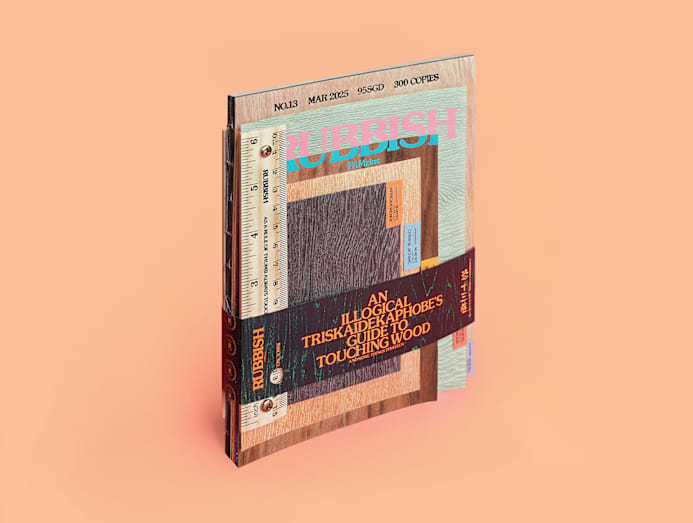
That is not to say he has given up designing. Lim channels his creative juices into other pathways, one of which is Rubbish Famzine. This is a magazine produced and launched in 2013 by him and his wife Claire, son Renn and daughter Aira. Part travelogue, part journal of their family time, it is an annual project that sees the four of them coming together to create it by hand where possible, such as by inserting photographs.
“This is how I challenge myself to do design outside of the Kinetic team. It’s a very subtle way of staying relevant,” he explained. In fact, the project has won a slew of accolades, including Design of the Year at the PDA 2015 and multiple honours at the D&AD Awards.
Magazines and exhibitions aside, Kinetic also does commercial work, servicing clients from Genki Sushi to Mini Singapore and real estate developers like CapitaLand and City Developments. The latter makes up the bulk of its portfolio, with the branding of high-end residential property Upperhouse at Orchard Boulevard by UOL among the latest.
Lim chatted with ease about how to create a luxurious identity, elaborating on classy typefaces and colour schemes that recall top-tier labels like Cartier (maroon) and Rolex (green). From brochures to videos and in-gallery communications, Kinetic is able to design them all.
MUSICAL ORIGINS
This confident, perspicacious version of Lim certainly did not develop overnight. Born into a musically inclined family, he seemed something of an outlier when he won an art competition at the tender age of five.
“The brief was to draw the Merlion,” he recalled. “I remember an aeroplane happened to fly by and I ended up depicting it larger than the Merlion. From that day onwards, all the presents I got were art supplies like crayons and coloured pencils.”
With a music teacher for a father and a professional soprano for a mother, his parents made sure their three children pursued music. While growing up, memories of his older brother and sister crying during violin lessons with their father led him to learn the piano instead.
“There was no escaping the musician in the house though. Although he didn’t play the piano, he would know if I was doing it properly and I would still get scolded if I didn’t. Dad was tough and strict on us, but I never once felt like he didn’t love us.”

Despite his forced education, Lim continued to harbour a love for music and went on to play the guitar in a post-punk band, Concave Scream, which released five albums. He struggled his way through school, clueless as to why he was being made to analyse books like King Solomon’s Mines in literature and memorise the hows and whys of the north-east monsoon in geography.
So switched off was he from the education system that he failed English at the O-level examinations. His academic standing improved only when he studied visual communications at Temasek Polytechnic. “I finally found the context in my life,” he said. “I was taught things like what a logo is for and why it is important for a brand.”
After graduation, he briefly pursued a career in advertising, working at DDB Singapore and Batey Ads, before freelancing as a designer when his father was diagnosed with liver cancer. “This was 1998 and among the three siblings, I was the only one who could possibly work from home,” he said.
The following year, Kinetic Interactive was started by four partners, one of whom, Sean Lam, was the frontman of Concave Scream. When the business took off, they asked Lim to join them to co-run the print arm, Kinetic Design & Advertising, with Roy Poh, which he did in 2001. Over the years, because of their personal circumstances, the partners were eventually bought out, with Lim the last one standing in 2019.
“I never wanted to start a business,” he mused. “My only ambition was to do good work that I’m proud of. I think I’ve managed to do that with the help of my team. When you look at it this way, I’m sure you can understand why I say I’m normal.”