What makes a city truly liveable? Designers and planners are looking beyond buildings and infrastructure
From murals and neighbourhood parks to better public spaces, architects and urban practitioners are exploring how cities can foster well-being, connection, creativity and a stronger sense of belonging.
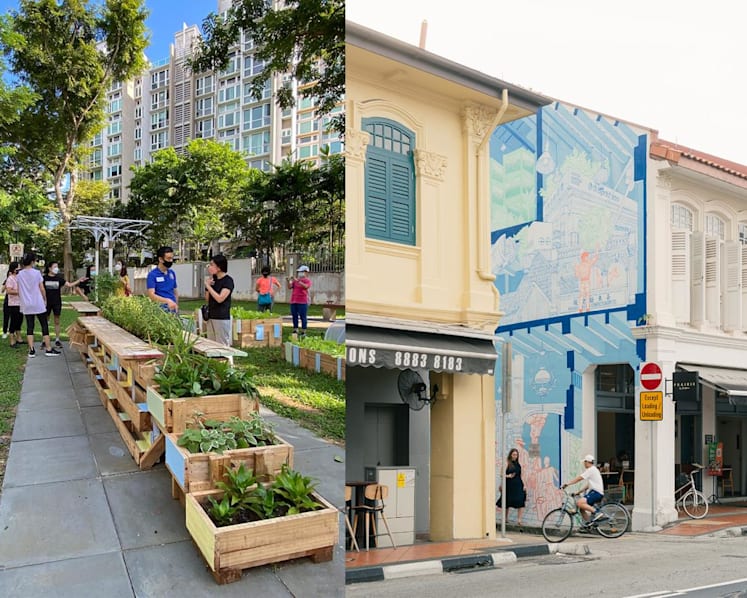
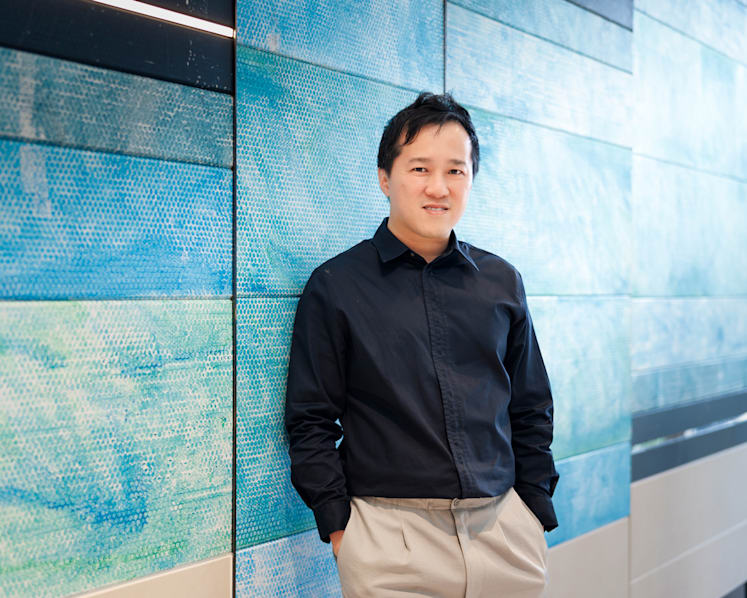
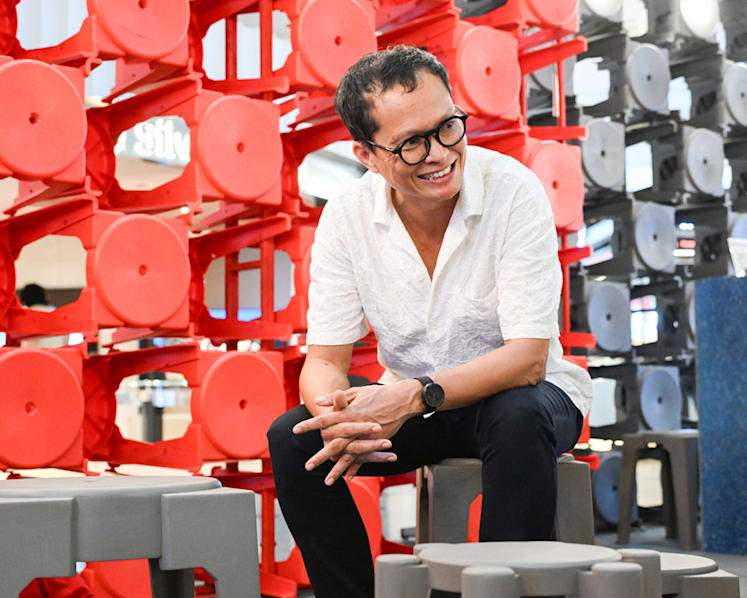
Designers and planners are looking beyond buildings and infrastructure to explore how public spaces can foster well-being, connection and a stronger sense of belonging. (Photos: Chong Keng Hua & Ong Chan Hao)

This audio is generated by an AI tool.


A group is gathered in a bustling kopitiam; a coolie hauls a heavy sack down the stairs; a woman hangs a laundered blouse on a bamboo pole. These scenes form part of a collage painted on the gable wall of 462 Joo Chiat Road. Titled Blueprint of a Shophouse, the mural was completed in November 2025 and depicts past, present and future vignettes of the neighbourhood, framed within a life-sized sectional representation of these distinctive buildings.
Leading the project from conception to completion was Lee Hui Lian, principal architect of OMG Atelier. While projects like this are not typically part of her day job creating homes, she readily takes on work that extends beyond building design.
“Buildings and infrastructure are the framework that enables meaningful experiences. I'm interested in how people relate to spaces emotionally and how design can create moments of pause, curiosity and connection. A mural is another way of practising architecture, just at a different scale and through a different medium,” said Lee.

Put this way, Blueprint offers a simple but striking example of how design can shape not just how a city looks, but how it is experienced. Public art projects like this are one of the ways to make cities more liveable. Interestingly, the conversation no longer only centres on economic, financial and sustainability metrics. Instead, built environment practitioners are increasingly concerned about matters such as how to enhance well-being, creativity and joy.
“A city can be environmentally efficient yet emotionally exhausting, or economically successful yet socially fragmented. The next evolution of city-making is to move beyond asking whether a city is productive or sustainable, and begin asking whether it enables people to flourish,” said Chong Keng Hua, a co-founder of COLOURS: Collectively Ours, a design consultancy specialising in collaborative public space design.
EMOTIONS CAN SIGNAL SUCCESS OR FAILURE
This call to rethink what cities should offer was also at the heart of the Art of Citymaking, held in Singapore in June. Its festival director, Anupam Yog, pointed to the rise of “city quitting” movements and the normalisation of urban loneliness as signs that something deeper needs to change. “I feel like we really need to radically reimagine these places. The city has to be something more, it needs to inspire us.”
How cities achieve this matters. Daniel Liu, managing director of urban advisory firm MORROW, summed up why: “We want people who live in cities to have better lives. Understanding how urban dwellers can experience them – the challenges of daily routine, the access to amenities and entertainment – these all matter.”

Assessing how people feel should not be dismissed as fluff. Chong, who is also vice president (academic) and provost of the Nanyang Academy of Fine Arts (NAFA), University of the Arts Singapore, emphasised that emotions can be indicators of whether a city is truly successful.
“When people feel safe, connected, inspired and valued, they are more likely to participate in their communities, volunteer, care for public spaces, support local businesses and look after one another. Healthy cities are those where people do not merely survive but thrive,” said Chong.
For Lee, the emotional impact of building design is central to her work. “As architects, we're trained to think about dimensions, materials and regulations, but ultimately those decisions influence everyday human experiences,” she said. For instance, a shaded walkway can encourage someone to walk instead of drive, while a generous bench can bring strangers together.
What this translates into is simply feeling well. Yog, who leads his own urban practice XDG Labs, defines it as being conscious, present and aware. “There was this idea of live, work, play. I actually think of it slightly differently – as live, move, rest. We need an opportunity to reset every night and to wake up alert,” he elaborated.
NO NEED FOR GRAND GESTURES
n practice, there are myriad ways to foster these positive emotions. Chong explores this through a method he calls “social archi-puncture”, examining how small, carefully designed interventions in physical spaces can have a disproportionate improvements on people’s daily lives.
“Sometimes, changing a parking lot, void deck or neighbourhood parklet creates a far greater impact on people’s lives than constructing another iconic, mega, multi-functional building,” he explained.
In his work with COLOURS, he describes quality of place through the four interconnected dimensions of physical, social and cultural well-being, and personal agency. When these come together, people begin to care more deeply about the places they inhabit. “This is what I call ‘placecaring’, an emerging ground-up movement beyond conventional placemaking,” he added.
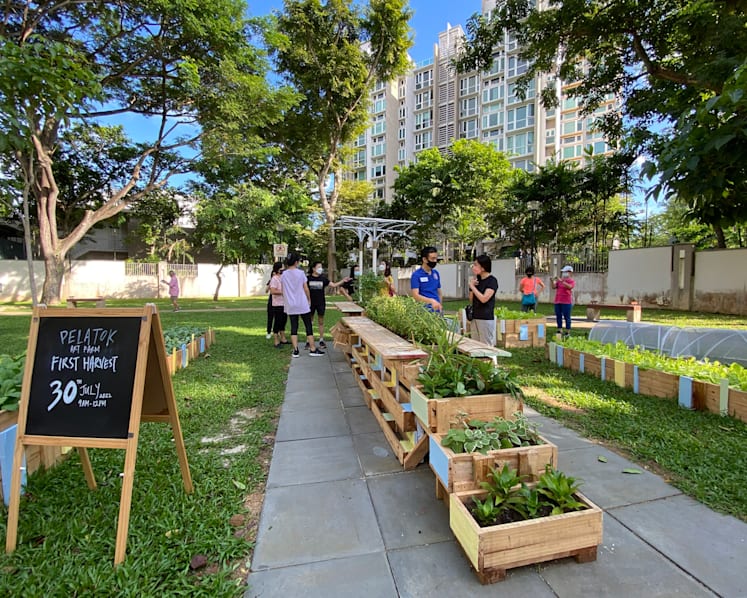
For instance, the Pelatok Art Farm was launched in Changi-Simei in 2022, bringing together art, design, farming and health to demonstrate how well-being can emerge through shared creative practice rather than hardware and healthcare alone.
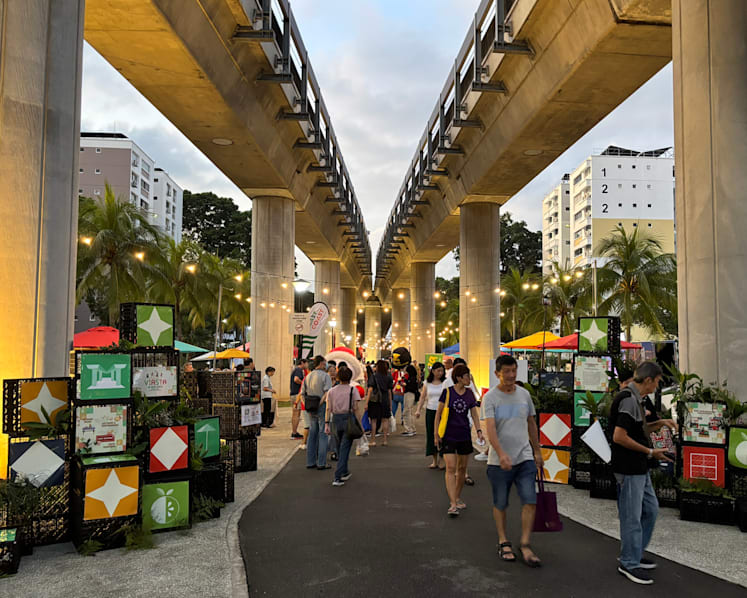
Two years later, a space beneath the Simei MRT viaduct was temporarily transformed with the local community for VIASTA!. It became a place for conversation and creative play that brought different groups together, demonstrating how public space can be reimagined through modest interventions.
Earlier this year, NAFA G Lab, which began as a collaboration between Central Singapore CDC and NAFA faculty and students, explored how satellite creative labs embedded in neighbourhoods could bring artists, designers and communities together to address local challenges creatively.
Lee’s Blueprint of a Shophouse mural is another prime example. Created as part of URA's Lively Places programme, it saw her collaborating with her colleague Lim Pin Jie, visual artists Jerome Ng Xin Hao and Shivshankar Nair, and muralist Lucas Goh Chen Ray.
The idea was to tell the story of the very building the mural sits on, reinterpreting fragments of sections, construction details and spatial ideas into a layered, visual narrative. “We wanted to reveal the hidden language of architecture and invite people to see a familiar shophouse in a new way. The mural therefore becomes both a celebration of the building and an invitation to rediscover it,” she said.
Even before it was completed, the project was drawing attention. Lee said slots for the community painting session were oversubscribed, with some people returning repeatedly in the hope of getting a chance to make their mark on the wall. “It reminded me that people care much more deeply about places when they've contributed to them, even in a small way,” she added.
URBAN PLANNING 101 STILL MATTERS
While it might be exciting to think about organising weekend markets and group meditation sessions in parks, sound planning fundamentals still need to be in place before any of these can occur. MORROW’s Liu cautioned that many cities are still not thinking strategically enough about linking economic and land use development.
For example, he pointed out that many Southeast Asian cities continue to seek foreign direct investment while overlooking basics such as where the people drawn there for work will live. “Without proper planning, when migration happens, informal settlements form, the informal economy expands, and living conditions deteriorate. This has a real negative economic impact: the city becomes more chaotic, friction in day-to-day activities increases, and the city suddenly seems less attractive,” said Liu.
Solutions can be found in preparing and gazetting strategic master plans that integrate economic, social and environmental trends. There is no one-size-fits-all template. Instead, planning data points such as nuances in family, culture and values need to be analysed in the march towards making the cities more liveable.
Liu revealed how MORROW developed a master plan for a Pacific nation facing high migration rates to neighbouring countries. One cause was how bored teenagers were committing crimes after school, making the informal settlements that had sprung up from planning policies unsafe. Knowing their passion for rugby – a cultural staple in the Pacific – more land was allocated for municipal parks with rugby pitches in the subsequent planning stages.
“The point is that cities need more clarity on what challenges are caused by which nuances, and find bespoke solutions to their unique challenges,” explained Liu.
Delivering these more responsive cities ultimately depends on the people planning and designing them. For Chong, that also means rethinking how future practitioners are trained, so that physical design and social programming are conceived together rather than sequentially. Then there is an AI-driven future to consider.
“Technology will increasingly optimise efficiency, automate routine work and generate information, but also average outputs and narrow creative diversity. The distinctive value of cities will therefore lie more in what makes us uniquely human: art, creativity, empathy, care, culture, courage and belonging,” said Chong.
Lee echoed the point: “The most memorable cities aren't necessarily the ones with the tallest buildings. They're the ones where people develop emotional attachments to places.”
Hopefully, for Singapore’s residents, one of those places will be where Blueprint of a Shophouse is. Even if it becomes part of a daily routine, joy and delight could still be had by noticing a new detail, or curiosity could be sparked to learn more about the history of the neighbourhood.
“Those moments are much harder to measure than infrastructure, but they're often what make a city feel like home,” said Lee.